
End-to-end encryption (E2E) means your data is encrypted on your device and can only be decrypted on the device of the person you're sending it to, or on your own devices. The company in the middle stores and carries it but can't read it, because it never has the key. It protects what you send and store; it doesn't protect a phone that's already unlocked, who you talk to, or what the other person does with it.
The idea in one picture
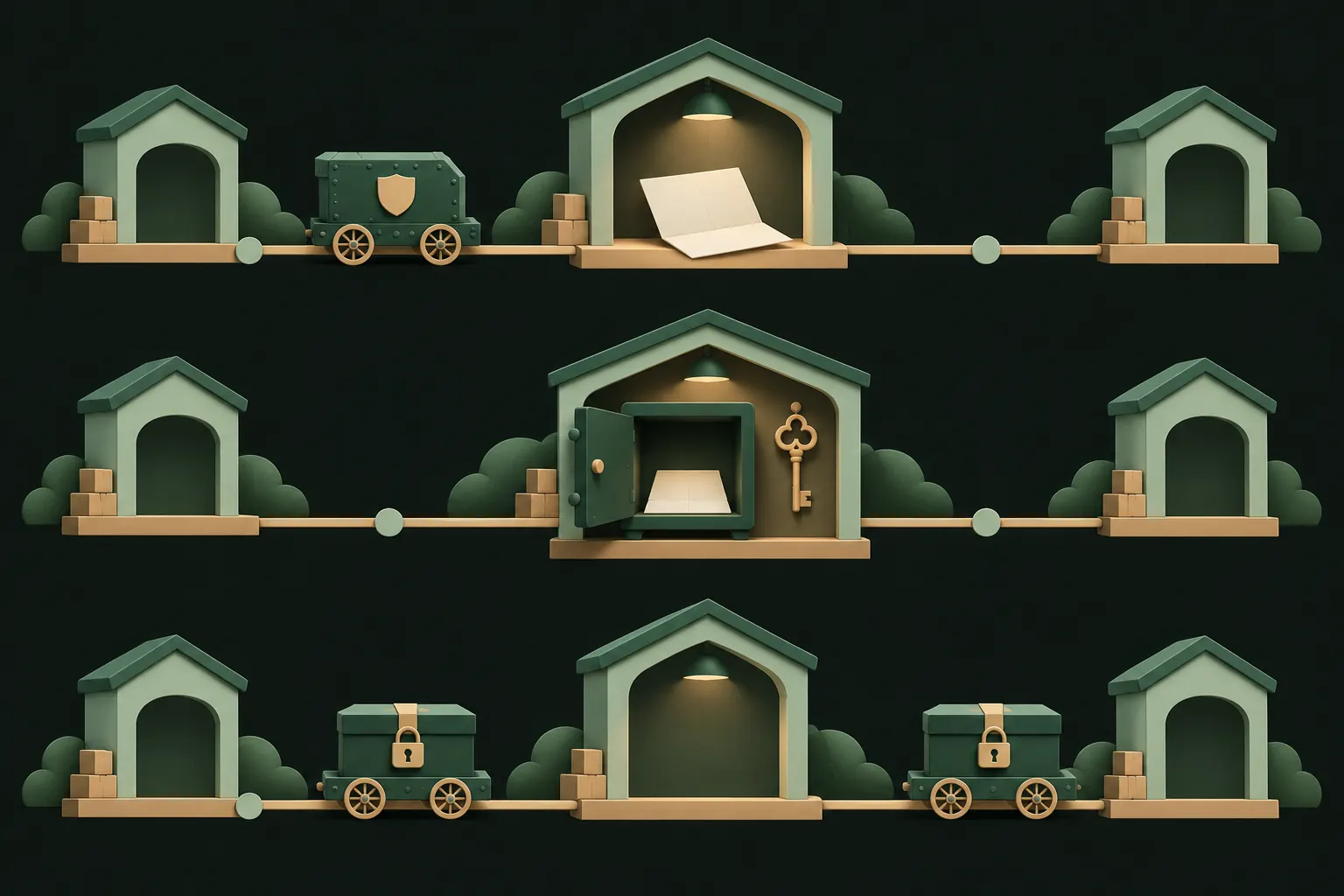
Imagine sending a letter in a locked box. You lock it, and only the recipient has the key. The postal service can carry the box, weigh it and see the address on it, but can't open it. If someone at the sorting office is curious, or a thief breaks into the depot, they get a locked box.
That's end-to-end encryption:
- The ends are your device and the recipient's (or your other devices).
- The middle is everything else: the app's servers, the cloud, the network.
- The key exists only at the ends.
Everything else in this guide is detail on that one idea.
In transit, at rest, end to end
Services love the word "encrypted". It can mean three very different things:
- Encrypted in transit. The connection between your phone and the server is encrypted (that's the padlock in your browser). Nobody on the Wi-Fi can read it, but the server gets your data in readable form.
- Encrypted at rest. The server stores your data encrypted on its disks, but the company holds the keys. That stops a stolen hard drive, not the company itself, a rogue employee, a hacker with access to the keys, or a legal demand.
- End-to-end encrypted. Encrypted before it leaves your device, with keys the company doesn't have. The server only ever sees ciphertext.
Most cloud services are the first two. Only the third means the company can't look, rather than won't.
Where you already use it on iPhone
Apple documents this in detail. Some highlights:
- iMessage and FaceTime are end-to-end encrypted. Apple says it can't decrypt the content of either.
- Passwords and Keychain, Health, Messages in iCloud and a dozen other categories are end-to-end encrypted by default in iCloud, under what Apple calls standard data protection.
- iCloud Photos, iCloud Backup, iCloud Drive and Notes are not end-to-end encrypted by default: Apple holds the keys so it can help you recover your account. They become end-to-end encrypted only if you turn on Advanced Data Protection.
- Even with Advanced Data Protection, iCloud Mail, Contacts and Calendars aren't end-to-end encrypted, and some metadata (like file types, dates, sizes and photo checksums) stays protected with keys Apple holds.
One gotcha: Messages in iCloud is end-to-end encrypted, but if iCloud Backup is on and Advanced Data Protection isn't, the key is included in your backup, which Apple can access. The full list is in Apple's iCloud data security overview. We go through the photo side specifically in is iCloud Photos end-to-end encrypted?
What it doesn't protect
End-to-end encryption is strong at one thing: keeping the middle out. It does nothing about:
- The ends themselves. If someone unlocks your phone, or the recipient's, they see everything in readable form. Malware on a device sees it too.
- Metadata. Who you talked to, when, how often, how big the files were. Depending on the service, that's often visible to the provider even when content isn't.
- Screenshots and forwarding. Once the recipient can see a photo, they can screenshot it, save it or show it to someone. No encryption scheme can make them unsee it.
- Backups. A chat app can be end-to-end encrypted while its backups aren't. WhatsApp backups, for example, are end-to-end encrypted only if you turn on End-to-end Encrypted Backup in the app.
- Weak recovery. If a forgotten password can be reset by email, someone must be able to restore the key, which means it isn't only at the ends.

E2E for photos you store vs photos you share
The same idea applies in two different ways to photos.
Photos you store. Here, both "ends" are you: the phone that took the photo, and your other devices. Encrypting end to end means the photo is encrypted on your iPhone before it goes to any cloud, and only your devices hold the key. A backup provider stores ciphertext.
Photos you share. Now the other end is someone else, and the key has to reach them without the server seeing it. The usual approaches are a key tied to the recipient's account or device (as in iMessage), or a secret you pass along separately, like a phrase or a link whose key part never reaches the server.
Sharing also brings in a limit that encryption can't solve: once the other person can see the photo, protecting it is up to them.
Three common misunderstandings
"End-to-end means anonymous." It doesn't. The service usually knows your account, your phone number or email, and who you're in contact with. It just can't read the content.
"End-to-end means safe from hackers." It means safe from hackers who break into the server. Someone who gets into your phone, or tricks you into installing malware, is at an end and sees everything.
"If it's end-to-end, I can't lose it." The opposite, if anything. Because the company can't decrypt your data, it can't recover it for you either. Keeping your password, recovery key or recovery phrase safe becomes your job.
How to tell if a service is really end-to-end
Marketing pages blur the terms, so check for these:
- Who holds the keys? Look for a security page or whitepaper that says keys are created on your device and never sent to the company. Our own is on the security page.
- What happens if you forget your password? If the company can restore your data with an email reset, it can read it. Genuine E2E services either can't help you or give you a recovery phrase or key in advance.
- Which data is covered? Messages but not backups? Files but not file names? A good service lists exactly what's end-to-end and what isn't, like Apple's table does.
- Is the encryption named? "Military-grade" isn't an algorithm. AES-256-GCM, the Signal protocol, published key derivation: those are.
- Has it been examined? Open-source code, published security models or independent audits all give you something other than the company's word.
For the related idea that the provider knows nothing about your data at all, see zero-knowledge encryption explained.
Questions
Is iMessage end-to-end encrypted?
Yes, messages and attachments between Apple devices are. But with iCloud Backup on and without Advanced Data Protection, the key for Messages in iCloud is stored in your backup, which Apple can access.
Are WhatsApp backups end-to-end encrypted?
Only if you turn it on: in WhatsApp, Settings, Chats, Chat Backup, End-to-end Encrypted Backup. You then protect the backup with a password or a 64-digit key.
Can the police read end-to-end encrypted messages?
Not by asking the service, which doesn't have the keys. They can read messages on an unlocked device, or in a backup that isn't end-to-end encrypted.
Does end-to-end encryption hide who I talk to?
Usually not. Content is protected, but metadata like who you contacted, when and how often often isn't, depending on the service.
Keep it private on your iPhone
No account. No analytics. Encrypted on your iPhone.